
 English
 Deutsch
 Español
 中文简体
中文简体



Content
- 1 Chemical Identity and Structural Overview
- 2 Key Physicochemical Properties That Drive Application Value
- 3 Application in Electrochemical Energy Storage Devices
- 4 Role in Electrodeposition and Surface Finishing
- 5 Use as a Reaction Medium in Organic Synthesis and Catalysis
- 6 Lubrication and Tribological Applications
- 7 Application Scenario Summary
- 8 Handling, Safety Considerations, and Environmental Context
Chemical Identity and Structural Overview
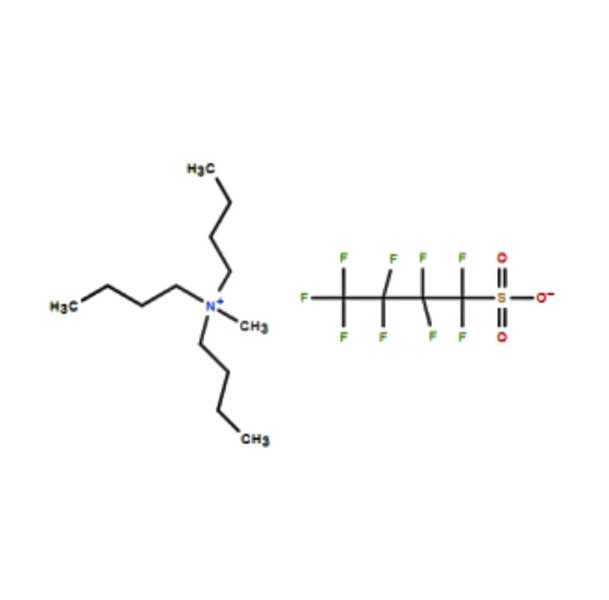
Methyltributylammonium nonafluorobutanesulfonate is an ionic liquid salt formed by combining a quaternary ammonium cation with a perfluorinated sulfonate anion. The cation — methyltributylammonium ([N1444]⁺) — consists of a central nitrogen atom bonded to one methyl group and three n-butyl chains, giving the molecule an asymmetric, bulky organic structure that suppresses crystalline packing and promotes liquid-state behaviour at or near room temperature. The anion — nonafluorobutanesulfonate (NfO⁻, C₄F₉SO₃⁻) — is a four-carbon perfluoroalkyl sulfonate in which all hydrogen atoms on the carbon backbone have been replaced by fluorine, producing an anion of exceptional electrochemical stability and hydrophobicity.
The compound is registered under CAS number 1174628-32-0 and carries the systematic IUPAC name tributyl(methyl)ammonium 1,1,2,2,3,3,4,4,4-nonafluorobutane-1-sulfonate. It belongs to the broader family of room-temperature ionic liquids (RTILs), materials that are entirely composed of ions yet remain liquid at temperatures below 100°C — and in many cases well below ambient temperature. This combination of ionic composition with liquid-phase behaviour gives the compound a unique set of physicochemical properties that distinguish it sharply from both conventional organic solvents and simple inorganic salts.
Key Physicochemical Properties That Drive Application Value
The practical utility of methyltributylammonium nonafluorobutanesulfonate across multiple application domains originates from a specific combination of physicochemical properties that are difficult to replicate simultaneously in conventional materials. Understanding these properties in detail is essential for evaluating where and how the compound can be most effectively deployed.
Negligible Vapour Pressure and Thermal Stability
Like virtually all ionic liquids, this compound has an extremely low vapour pressure — effectively unmeasurable under normal atmospheric conditions. This property eliminates evaporative losses during processing and use, a critical advantage in applications where solvent evaporation would compromise mass balance, product purity, or process safety. Thermogravimetric analysis of analogous nonafluorobutanesulfonate ionic liquids consistently demonstrates onset decomposition temperatures above 300°C, providing a wide liquid operating window that vastly exceeds those of common organic solvents. This thermal stability makes the compound suitable for high-temperature electrochemical and catalytic processes where conventional electrolytes or solvents would decompose or volatilise.
Wide Electrochemical Window
The nonafluorobutanesulfonate anion is electrochemically inert across a wide potential range due to the strong electron-withdrawing effect of the nine fluorine atoms on the carbon backbone, which substantially raises the anion's oxidation potential relative to non-fluorinated sulfonate counterparts. Combined with the relatively high cathodic stability of the methyltributylammonium cation, the compound exhibits an electrochemical window typically exceeding 4.0–5.0 V in carefully controlled conditions. This wide window is among the most valued properties of fluorinated ionic liquids in electrochemical device applications, where it permits operation at voltages that would decompose aqueous or conventional organic electrolytes.
Hydrophobicity and Immiscibility with Water
The perfluoroalkyl chain of the nonafluorobutanesulfonate anion confers strong hydrophobicity on the ionic liquid, resulting in limited water miscibility — a property that sharply distinguishes it from many shorter-chain or non-fluorinated ionic liquids that are hygroscopic or fully water-miscible. This hydrophobicity enables the formation of stable biphasic systems with aqueous phases, which is exploited in liquid-liquid extraction and biphasic catalysis applications. It also reduces the compound's sensitivity to atmospheric moisture absorption during handling and storage, simplifying practical use compared to more hygroscopic ionic liquid families.
Application in Electrochemical Energy Storage Devices
The most extensively researched application domain for methyltributylammonium nonafluorobutanesulfonate and closely related fluorinated quaternary ammonium ionic liquids is as electrolyte components in electrochemical energy storage systems. Conventional lithium-ion battery electrolytes based on organic carbonates such as ethylene carbonate and dimethyl carbonate are flammable, volatile, and limited in their electrochemical window — constraints that become critical safety and performance concerns in large-format batteries for electric vehicles and grid storage applications.
Ionic liquid electrolytes incorporating nonafluorobutanesulfonate anions address these limitations through their non-flammability, negligible volatility, and wide electrochemical window. In lithium battery research, such ionic liquids are used as neat electrolytes or as co-solvents blended with conventional electrolytes to improve safety at elevated temperatures and to enable the use of high-voltage cathode materials operating above 4.5 V vs. Li/Li⁺ — voltages at which carbonate electrolytes undergo irreversible oxidative decomposition. The relatively low viscosity achievable with the asymmetric methyltributylammonium cation, compared to more symmetric quaternary ammonium cations, supports adequate ionic conductivity for practical battery operation.
In electrochemical double-layer capacitors (supercapacitors), the wide electrochemical window of fluorinated ionic liquid electrolytes directly translates into higher energy density, since the energy stored scales with the square of the operating voltage. Research groups have demonstrated supercapacitor cells operating at 3.5–4.0 V using ionic liquid electrolytes of this family, compared to the 2.7 V practical limit of acetonitrile-based electrolytes — a potential increase that more than doubles the theoretical energy storage per unit electrode mass.
Role in Electrodeposition and Surface Finishing
Electrodeposition of metals and alloys from ionic liquid media has emerged as a technically significant alternative to conventional aqueous electroplating for applications requiring the deposition of electropositive metals — including aluminium, titanium, tantalum, and silicon — that cannot be deposited from water-based electrolytes due to hydrogen evolution and oxide formation at the required reduction potentials. Methyltributylammonium nonafluorobutanesulfonate, either as a neat ionic liquid or as a component of a mixed ionic liquid system, provides a stable, wide-window electrochemical medium for these depositions.
Aluminium electrodeposition from ionic liquids is of particular industrial interest as a replacement for chromium-based hard plating in corrosion protection of aerospace and automotive components. The nonafluorobutanesulfonate anion's hydrophobicity ensures that the ionic liquid electrolyte maintains low water content during deposition, preventing oxide contamination of the deposited aluminium film and producing coatings with superior adhesion and corrosion resistance compared to those obtained from more hygroscopic electrolyte systems. The wide liquid temperature range of the ionic liquid also allows deposition temperature to be tuned to control grain size and coating morphology without approaching the decomposition temperature of the electrolyte.
Use as a Reaction Medium in Organic Synthesis and Catalysis
Ionic liquids have attracted sustained attention as designer solvents for organic synthesis and homogeneous catalysis, offering the ability to tune solubility, polarity, and miscibility with other phases through systematic variation of the cation-anion combination. Methyltributylammonium nonafluorobutanesulfonate is of specific interest in biphasic catalytic systems where a catalyst is preferentially dissolved in the ionic liquid phase, and the substrate and products partition into an immiscible organic or aqueous phase for efficient separation and catalyst recovery.
Biphasic Catalysis and Catalyst Immobilisation
In transition metal-catalysed reactions such as hydroformylation, Heck coupling, and carbonylation, the catalyst — typically a palladium, rhodium, or ruthenium complex — is dissolved in the ionic liquid phase while the organic substrate and product occupy a separate organic phase. The perfluorinated character of the nonafluorobutanesulfonate anion enhances the affinity of the ionic liquid phase for fluorinated or partially fluorinated catalysts and ligands, enabling selective catalyst immobilisation through fluorophilic interactions. This fluorophilic ionic liquid approach allows the catalyst to be recycled across multiple reaction cycles with minimal leaching into the product phase, addressing one of the primary cost and regulatory concerns in industrial homogeneous catalysis.
High-Temperature Reaction Media
The thermal stability of methyltributylammonium nonafluorobutanesulfonate above 300°C makes it a viable reaction medium for high-temperature synthetic processes that would destroy conventional organic solvents. This is particularly relevant in the synthesis of inorganic nanoparticles and metal oxide materials via ionothermal synthesis, where the ionic liquid serves simultaneously as solvent, template, and sometimes nitrogen or carbon source, yielding materials with controlled morphology and surface chemistry that are difficult to achieve through aqueous hydrothermal routes.
Lubrication and Tribological Applications
Ionic liquids with perfluorinated anions have been extensively evaluated as lubricants and lubricant additives for applications in extreme environments — including vacuum, high temperature, and chemically aggressive conditions — where conventional hydrocarbon-based lubricants fail through evaporation, oxidative degradation, or chemical reaction with the substrate. The negligible vapour pressure of methyltributylammonium nonafluorobutanesulfonate makes it suitable for vacuum tribology applications in aerospace mechanisms, precision instruments, and semiconductor manufacturing equipment where outgassing from the lubricant must be minimised to avoid contaminating optical or electronic components.
As an additive to conventional base oils, fluorinated ionic liquids of this type function both as friction modifiers and as anti-wear agents. The ionic nature of the compound allows it to adsorb onto charged metal oxide surfaces at the tribological contact, forming a protective boundary film that reduces direct metal-metal contact under high load conditions. Studies on steel-on-steel and aluminium-on-steel contacts have demonstrated significant reductions in both coefficient of friction and wear volume with ionic liquid additive concentrations of 0.5–2.0 wt% in PAO (poly-alpha-olefin) base oils — performance levels competitive with conventional zinc dialkyldithiophosphate (ZDDP) anti-wear additives but without the phosphorus and sulphur emissions concerns associated with ZDDP combustion in engine applications.
Application Scenario Summary
Handling, Safety Considerations, and Environmental Context
As with all perfluorinated compounds, the environmental and toxicological profile of methyltributylammonium nonafluorobutanesulfonate requires careful consideration. The nonafluorobutanesulfonate anion belongs to the short-chain perfluoroalkyl sulfonate (PFAS) family, which has attracted regulatory scrutiny due to the environmental persistence of longer-chain PFAS compounds such as PFOS (perfluorooctanesulfonate). Short-chain variants including C4 sulfonates were developed partly in response to regulatory pressure on longer-chain homologues, and available ecotoxicological data suggests lower bioaccumulation potential — though persistence in the environment remains a concern shared across the PFAS class.
From a practical handling perspective, the compound presents low acute toxicity via dermal and inhalation routes under normal use conditions, owing to its negligible vapour pressure and the absence of reactive functional groups that would generate toxic decomposition products at ambient temperatures. However, thermal decomposition above 300°C produces hydrogen fluoride and fluorinated sulfur oxides, requiring adequate ventilation and appropriate personal protective equipment in high-temperature processing environments. Users working with this compound in research or industrial settings should consult current Safety Data Sheets and comply with applicable PFAS-related chemical regulations in their jurisdiction, as this regulatory landscape is evolving rapidly in both the European Union and North America.
For researchers and industrial chemists evaluating methyltributylammonium nonafluorobutanesulfonate for a specific application, the compound's combination of wide electrochemical window, thermal stability, hydrophobicity, and controllable miscibility with organic phases represents a genuinely useful toolset. Its value is highest in technically demanding applications where these properties act in combination — particularly electrochemical systems requiring both wide voltage operation and non-flammability, and biphasic catalytic systems requiring selective phase partitioning with thermal robustness — rather than in applications where a single property is required and a simpler, less costly material could provide it adequately.