
 English
 Deutsch
 Español
 中文简体
中文简体



1-Allyl-3-vinylimidazolium chloride is a functionalized ionic liquid that has drawn increasing interest in materials science and electrochemistry due to its dual polymerizable groups and inherent ionic conductivity. Identified by CAS Number 100894-64-2, this compound combines the imidazolium ring structure common to many ionic liquids with both an allyl and a vinyl substituent, giving it chemical versatility that extends well beyond typical solvent applications. This article examines the compound's structure, how it is synthesized, its key physical and chemical properties, and the practical applications driving demand across specialty chemical and materials manufacturing sectors.
Content
Chemical Identity and Structure
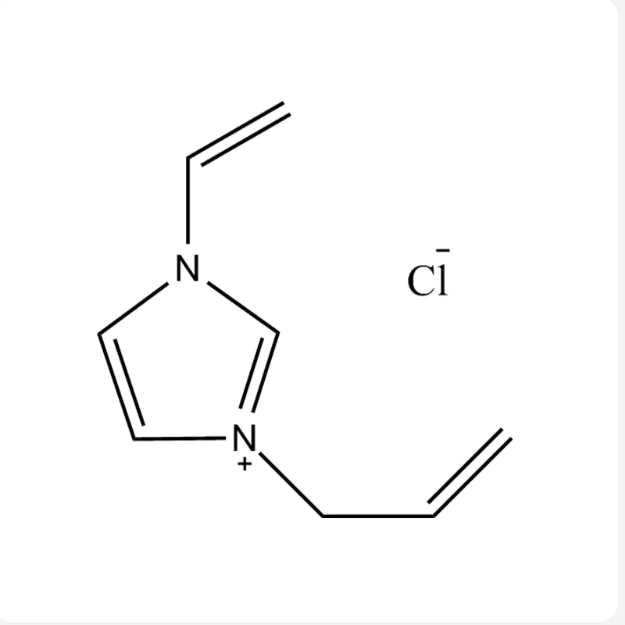
1-Allyl-3-vinylimidazolium chloride carries the molecular formula C8H11ClN2 and a molecular weight of approximately 170.64 g/mol. The molecule is built around an imidazolium cation, a positively charged five-membered ring containing two nitrogen atoms, with an allyl group attached at one nitrogen position and a vinyl group attached at the other. A chloride anion balances the positive charge on the ring, forming the overall salt structure. This arrangement is commonly abbreviated in supplier catalogs and technical literature as [VAIM]Cl, a shorthand that reflects its identity as a vinyl-allyl imidazolium chloride salt.
What distinguishes this compound from many other imidazolium-based ionic liquids is the presence of two separate polymerizable carbon-carbon double bonds within the same molecule, one on the allyl chain and one on the vinyl group. This dual functionality allows the compound to participate in radical polymerization reactions from either or both reactive sites, a feature that underpins much of its value in advanced materials development.
Key Physical and Chemical Properties
| Property | Value |
| CAS Number | 100894-64-2 |
| Molecular Formula | C8H11ClN2 |
| Molecular Weight | 170.64 g/mol |
| Physical Appearance | Colorless to light yellow to reddish brown liquid |
| Typical Purity Grade | 95% to 97% |
| Recommended Storage | 2-8 degrees Celsius |
Because the compound is typically supplied as a liquid rather than a crystalline solid, handling and dosing in laboratory or production settings is generally straightforward compared to solid ionic liquid precursors, though the cool storage requirement reflects its sensitivity to degradation or premature polymerization at elevated temperatures.
How the Compound Is Synthesized
The standard synthetic route to 1-allyl-3-vinylimidazolium chloride involves the quaternization of 1-vinylimidazole with allyl chloride, a reaction that forms a new carbon-nitrogen bond at the imidazole ring's second nitrogen position. Mechanistically, this transformation proceeds through an SN2 bimolecular nucleophilic substitution, in which the nitrogen atom of 1-vinylimidazole acts as a nucleophile attacking the electrophilic carbon of allyl chloride while the chloride ion is displaced as a leaving group. The result is the imidazolium cation paired with the displaced chloride anion, yielding the final salt product.
Reaction conditions play an important role in achieving high yield and purity. Polar aprotic solvents are generally favored for this type of SN2 reaction because they solvate the cation without strongly solvating the nucleophile, and solvents such as ethyl acetate have been used successfully in the synthesis of related vinylimidazolium salts. Controlling the molar ratio of reactants is equally important, since a slight excess of allyl chloride is often used to drive the reaction toward complete conversion, while avoiding a large excess helps minimize side reactions and simplifies downstream purification. The reaction is also exothermic, meaning solvent choice and controlled addition rates help manage heat dissipation during scale-up production.
Why the Dual Vinyl-Allyl Structure Matters
The presence of two distinct polymerizable groups is what sets this compound apart from single-function ionic liquid monomers. In polymer chemistry, having both a vinyl and an allyl reactive site on the same cation opens the door to more complex network structures, including cross-linked poly(ionic liquid) materials where the vinyl group participates in the primary chain-growth polymerization while the allyl group remains available for secondary cross-linking or post-polymerization modification.
This structural flexibility allows chemists to fine-tune the resulting polymer's mechanical properties, ionic conductivity, and cross-link density by controlling how much of each reactive group participates in the final network. For applications requiring both structural integrity and consistent ion transport, such as solid polymer electrolytes, this level of tunability is a meaningful advantage over ionic liquid monomers with only a single polymerizable site.
Primary Industrial and Research Applications
1-Allyl-3-vinylimidazolium chloride is used primarily as a specialty monomer and functional additive rather than as a bulk industrial chemical, with its applications concentrated in several advanced materials and energy-related fields.
- Ionic liquid and poly(ionic liquid) synthesis, where the compound serves as a polymerizable monomer for building functional ion-conductive polymer networks.
- Electrochemistry and materials science research, where its ionic conductivity and reactive double bonds support the development of specialty electrolytes and functional coatings.
- Energy storage applications, including exploratory work on solid or gel polymer electrolytes for batteries and related electrochemical devices.
- Metal plating and surface treatment processes, where ionic liquid additives can influence deposition characteristics and coating uniformity.
- Custom chemical synthesis intermediates, supplied to research and development teams working on novel imidazolium-based materials.
As an ionic liquid with applications spanning electrochemistry and materials science, the compound supports innovations and efficiency improvements across a range of industrial processes, particularly where researchers need a monomer that combines ionic character with polymerization versatility in a single molecule.
Handling and Safety Considerations
Like many reactive ionic liquid intermediates, 1-allyl-3-vinylimidazolium chloride requires careful handling in laboratory and production environments. Safety documentation associated with the compound identifies hazard statements including skin and eye irritation as well as respiratory irritation risk, meaning appropriate personal protective equipment, including gloves and eye protection, should be used during handling. Because the molecule contains reactive vinyl and allyl groups, exposure to elevated temperatures, light, or radical initiators outside of a controlled reaction setting can trigger unintended polymerization, which is part of why refrigerated storage is generally recommended to preserve the material's stability and shelf life.
Facilities working with this compound at scale should also account for its liquid form during transport and storage, ensuring containers remain sealed and stored away from heat sources or incompatible oxidizing agents that could accelerate degradation or unwanted side reactions.
Sourcing Considerations for Buyers
Buyers evaluating suppliers of 1-allyl-3-vinylimidazolium chloride should pay close attention to purity grade, since research and production applications often require consistent quality above 95% to ensure reliable polymerization behavior and reproducible material properties. Confirming batch-specific certificates of analysis, along with documentation of storage and handling history, helps ensure the material has not degraded prior to use. For applications involving precise polymer network design, verifying supplier consistency across multiple production batches is particularly important, since variations in trace impurities can influence polymerization kinetics and final material performance in sensitive applications such as electrolyte development.
Final Thoughts
1-Allyl-3-vinylimidazolium chloride occupies a specialized but growing niche within ionic liquid chemistry, valued for its dual polymerizable structure and the flexibility it offers in designing functional polymer materials. From its synthesis through quaternization with allyl chloride to its emerging role in ion-conductive polymer networks and electrochemical research, the compound's combination of chemical reactivity and ionic character makes it a valuable building block for researchers and manufacturers working at the intersection of materials science and energy technology.