
 English
 Deutsch
 Español
 中文简体
中文简体



Content
- 1 Introduction: why antistatic additives matter for adhesive tapes
- 2 Electronics assembly and ESD-sensitive production
- 3 Cleanroom operations and particle-sensitive assembly
- 4 High-speed converting and automated packaging lines
- 5 Printing, labeling and film handling
- 6 Medical packaging and sterile barrier systems
- 7 Automotive electronics and sensor assembly
- 8 Comparison table: application needs vs. antistatic performance
- 9 Selection and testing checklist
- 10 Practical note for linking
- 11 Conclusion: match additive performance to application risk
Introduction: why antistatic additives matter for adhesive tapes
Static charge on tape surfaces or on substrates can cause handling problems, particulate attraction, electrostatic discharge (ESD) damage and poor winding behavior in high-speed lines. Antistatic additives incorporated into adhesive tape formulations reduce surface resistivity, improve unwind behavior and cut dust attraction — outcomes that matter most in sensitive manufacturing, packaging and cleanroom environments. This article focuses on the specific applications that benefit most from antistatic adhesive tape additives and provides practical guidance for choosing and testing solutions.
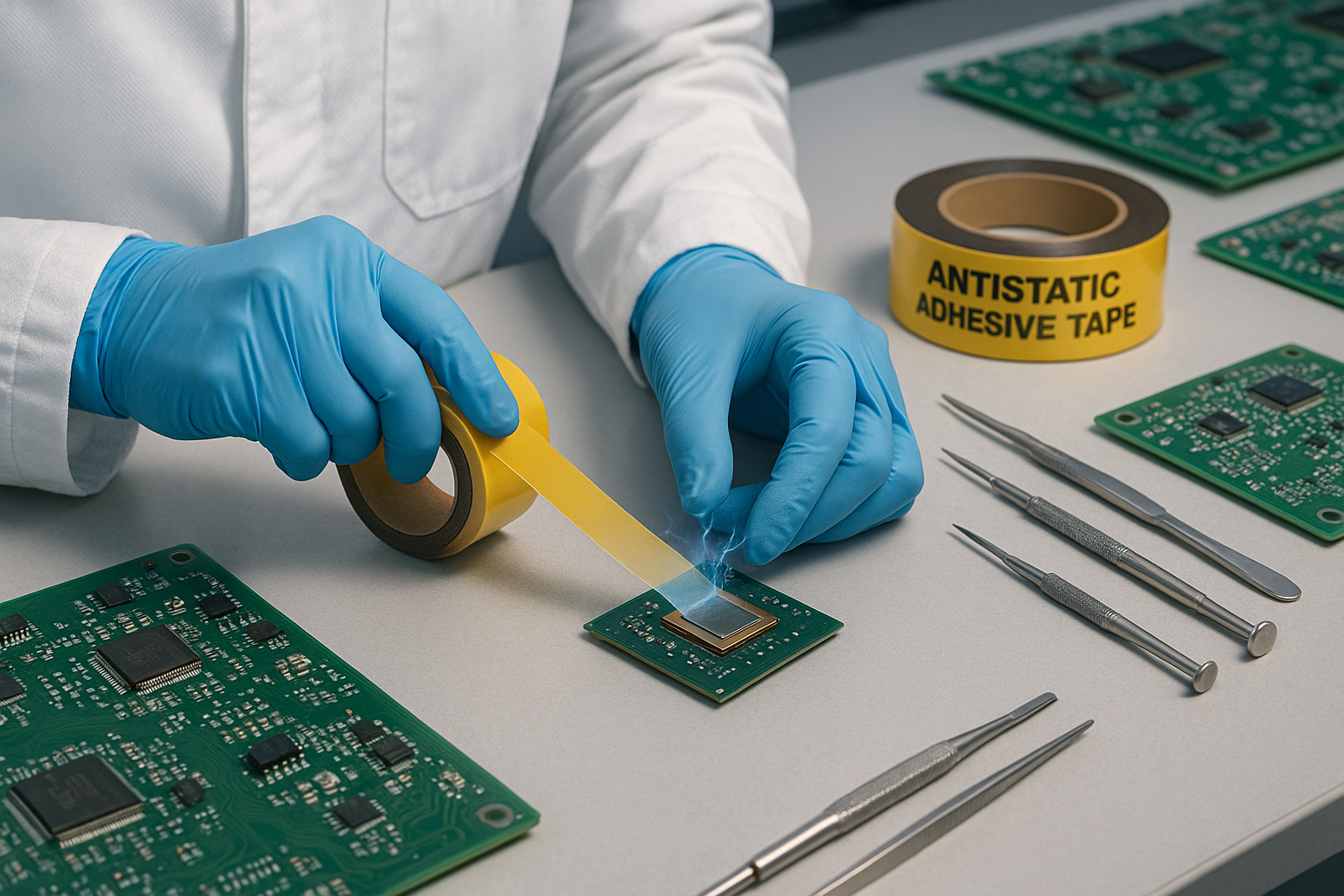
Electronics assembly and ESD-sensitive production
Printed circuit board (PCB) assembly and the handling of semiconductor components are among the highest-priority use cases for antistatic tapes. In pick-and-place operations, tape feeders and carrier tapes that accumulate charge can misfeed or attract contaminants; in reflow and wave-solder environments, charged particles can cause solder defects. Using tapes with controlled surface resistivity helps maintain ESD-safe process windows and minimizes assembly failures caused by electrostatic events.
Recommended tape attributes for electronics
- Surface resistivity in the dissipative range (typically 10^6 to 10^11 Ω) for controlled discharge.
- Stable antistatic performance after repeated transport and temperature cycles.
- Compatibility with common fluxes, solvents and cleanroom cleaning agents.
Cleanroom operations and particle-sensitive assembly
In controlled environments where particulate contamination is tightly limited, tapes that attract dust because of electrostatic charge create a direct contamination risk. Antistatic tape formulations reduce electrostatic attraction to particles and fibers, improving final product cleanliness in optical component assembly, medical device packaging and laboratory equipment manufacturing.
Practical handling tips
- Specify antistatic surface finish and validate with particle-count tests after tape application.
- Use low-shedding carrier materials and avoid high-tribo pairings that recreate charge during unwind.
High-speed converting and automated packaging lines
At line speeds, tapes and films that build charge can misalign, cling, or produce static sparks that disrupt automation. Antistatic additives help maintain predictable unwind tension and adhesion characteristics, reducing downtime and waste. Line engineers also benefit from tapes that retain antistatic behavior under fast shear and elevated local temperatures produced by friction.
Design considerations for converting
- Choose additives that migrate slowly to avoid residue transfer to machinery or product surfaces.
- Verify additive compatibility with release liners and corona/priming treatments used in converting lines.
Printing, labeling and film handling
Printers, labelers and film processors are sensitive to static because it affects registration, ink deposition and print quality. Antistatic tape additives can stabilize web handling and reduce static-related print defects, particularly when thin films are tensioned over rollers and nip points.
Medical packaging and sterile barrier systems
Medical packaging often requires sterile, particle-free surfaces; static-attracted dust and fibers can compromise sterility assurance levels (SAL). Adhesive tapes used for pouch seals, construction of sterile barriers or temporary holding during assembly should minimize static attraction and avoid additive migration that could affect biocompatibility or package integrity.
Regulatory and biocompatibility checks
- Confirm additives meet relevant ISO or USP guidelines where the tape contacts sterile surfaces.
- Use extractables/leachables testing if the additive is likely to contact medical devices or packaging seals.
Automotive electronics and sensor assembly
Modern vehicles include many sensitive sensors and ECUs whose manufacture and testing require ESD control. Tapes used in wire harnessing, temporary fixturing during PCB handling or in sensor module assembly benefit from antistatic properties to reduce latent field failures caused by static stress during production and test.
Comparison table: application needs vs. antistatic performance
The table below summarizes typical application priorities and the antistatic performance attributes to prioritize when specifying tape or additives.
| Application | Primary static risk | Key additive attributes |
| Electronics assembly | ESD and component misfeed | Dissipative range resistivity, thermal stability |
| Cleanrooms | Particle attraction | Low migration, non-shedding, low particulate generation |
| High-speed converting | Web handling issues and sparks | Durable performance under friction, slow migration |
| Medical packaging | Contamination risk and regulatory concerns | Biocompatibility, low extractables |
Selection and testing checklist
Before specifying an antistatic tape or additive, evaluate the material against process and product requirements. Key tests include surface resistivity, charge decay time, particle attraction under controlled airflow, and migration/residue after thermal aging. Also validate spray- or solvent-based application methods if antistatic agents are applied as a coating post-production.
- Measure initial surface resistivity and repeat after 500 cycles of unwind/rewind.
- Perform charge decay tests per relevant ESD standards for electronics environments.
- Assess residue and adhesion retention after thermal and humidity aging.
Practical note for linking
If you intend to insert a product or technical page link, anchor the phrase Adhesive Tape Antistatic Agent so it is clear to readers and search engines what the destination covers.
Conclusion: match additive performance to application risk
Selecting the right antistatic approach for adhesive tapes is an application-driven decision. High-risk areas such as electronics assembly, cleanrooms and medical packaging require stable, low-migration additives with validated ESD and particulate performance. For high-speed converting and general packaging, focus on durable antistatic behavior that preserves unwind and print quality. Use the checklists and tests above to reduce trial-and-error and achieve reliable results in production.